
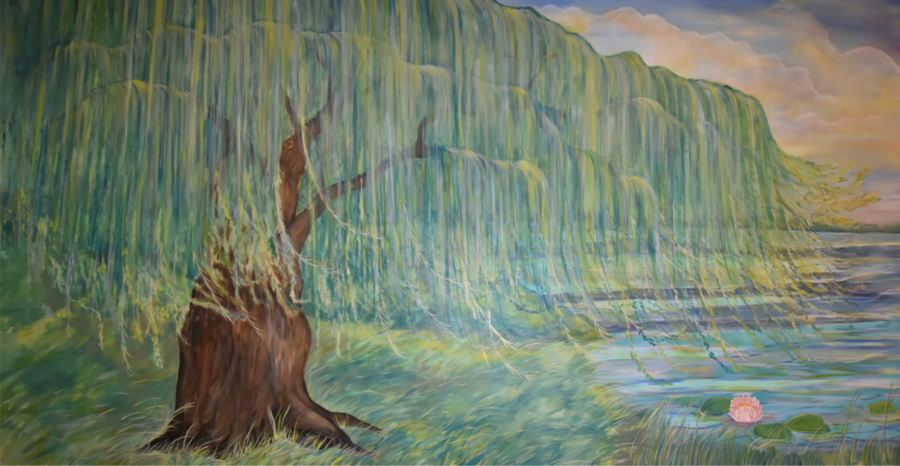
I add pieces like this in my book between the pages of my letters to my illness.
I want others to see what I saw, through my eyes, through the pain, and especially through the people who helped me heal.
My healthcare workers weren’t just names on charts. They were my lifelines.
A few years ago, I saw one of my doctors in the hallway. She asked how I was doing.
I smiled and said, “Great.”
Then I paused and said, “Thank you. I didn’t think I’d get through that.”
She didn’t hesitate and said,
“But I knew you would.”
And smiled.
I still get to see the nurse who once helped me through my worst days.
Now, she’s one of the closest people in my life.
And,I finally got to paint my willow in the place it mattered most for me.
My First Steps
2010
I step out of my car and feel the soon-to-be spring breeze. My birthday is a month away, and I have nothing to celebrate.
I grab my purse, stuffed with reminders of my old self, and take out a paper. As I slam the car door, I turn toward a building that doesn’t look like it could fix anything, and my heart sinks into a pit of disappointment and dread.
I walk toward it anyway. I have to. Willows weep around it, as if they know what’s housed inside. My gut churns, my hands tremble, and I clench my jaw. Less than six months ago, I was taking my kids to school, making dinners, and creating and selling my art.
I had a life.
Now, I wake up, medicate, put on my lipstick and big sunglasses, take the kids to school, then come home, set an alarm for pickup, and sleep the day away. When I can’t sleep, I go to a coffee shop just to feel safe.
I used to be a broken toy wrapped in pretty paper, but now, even the paper is fading.
At the entrance, a menagerie of patients makes small talk. The scent of old and new cigarettes clings to the air. A man with greasy hair and yesterday’s eyes says, “Hello there,” as a white cloud of smoke curls out from his mouth. I nod politely and open the door.
Inside, a long, worn-out hall stretches ahead, lined with scuffed, tacky paint, devoid of any life. This is my follow-up care? This, here, is the place I’ve been looking forward to? This is the place that’s supposed to convince me my life is worth something?
My mouth dries. I can’t swallow.
I expected too much… again.
I look down the long hall, windows lining the walls, and I feel as if I let out all the anger, rage, sorrow, and disappointment, I would break them all. My heart booms in my ears as my breathing gets heavier. I remember that padded room with a dirty mattress; now here I am, much older, with the same feeling. I look back at the door. It’s fight-or-flight time.
A staff member sees my wide eyes. “Can I help you?”
I stumble over my words.
“I’m lost.”
“I have an appointment.”
I show her my paper. She leads me through a set of doors and points down a hall. I smile, and she smiles back.
I look around the waiting room, people with downcast eyes, fidgeting hands, hair that looks three days old. I square my shoulders, take off my bright red scarf, and smooth out my shirt. No one prepares you for the feeling of losing yourself. No one tells you how displaced you’ll feel as you mimic your old mannerisms for some sense of dignity.
But my father always said: Make a good impression, no matter what. But there must be exceptions?
Today, I showered for the first time in four days. I carefully picked out my clothes. I put on full makeup.
My façade of self-preservation.
My armour of denial.
A doctor once told me I needed to wear jogging pants and mess myself up a little if I wanted to be listened but I refuse. Because this is all I have left of who I was.
I’ve lived in this city for years and never knew this place existed until the psychiatrist at the Tower referred me here. He said, “You need more extensive treatment. You need to be followed by a psychiatrist.”
But why wasn’t I referred before?
Why did I have to break before anyone listened?
I told doctors I was overmedicating just to get through the day, or stopping medication entirely. I told them that after my child was born, I felt scared, empty, and had terrifying thoughts. I told them my moods went up and down constantly. I told them I couldn’t sleep.
I told them I didn’t want to live.
Thirteen years since the padded room incident, different diagnoses, different pills, different hospitals, same outcome.
I begged. I told my truth over and over again until the truth didn’t matter. So, I shut off.
I went into survival mode for the babies who needed me.
They still do.
I told the Tower doctor I would stay on this new medication, and I have. He explained my new diagnosis and why it matters. It isn’t working yet, but I won’t put my family through that again. I will swallow whatever I need to until something finally works. I don’t care about the side effects or how they make me feel this time.
Down the dreary hall, a woman pulls me from my thoughts. She has soft, kind features, and her hair is rolled into a bun.
“April?” she says cheerfully.
I get up. I’ve been a patient long enough to know the drill, follow behind staff or in front, depending on your mental state. But this time, she walks beside me and asks, “Did you get here okay?”
She takes me into a dim room that smells faintly of incense. A doctor sits inside, legs crossed, dressed immaculately. She smiles gently, like you would to a feral animal not to scare it off, and introduces herself. She looks me in the eye, and it feels like she’s already reading right through me.
I try not to fidget.
I analyze her back.
I know her type. To some, she might seem arrogant, but that’s only because she’s a woman. In a man’s world, she’d be called what she really is, powerful.
On her desk is a photo of a little girl and a man with glasses. Every psychiatrist I’ve met before had no photos, just degrees and cold walls. I can tell she doesn’t just walk to her own beat; she creates it.
The nurse beside her radiates warmth, a Southern, down-to-earth charm that reminds me of the church women in Florida. I used to sit in the pews, listening to them sing while in my depressive states, their joyful voices vibrating through the emptiness inside me.
For now, in this room with them, I feel a sense of calm. Maybe even safety.
They tell me this will be a long intake appointment. I nod. I’ve done this four times before, with no follow-up and a new script each time.
“If you need a break, just let us know,” the nurse says gently.
I answer question after question. But this time feels different. They don’t stick to the typical psychiatry script.
They look at me. They see me.
And after I answer, they say things like:
“I know how hard this must be.”
“You’ve been strong for a long time.”
It feels like relief to hear those words, like I’ve been holding onto the ledge, and I can finally let go.
I am heard.
No more begging.
Through my tears, they ask about my kids, my husband, my art, my life.
They say: To treat the illness, we need to know the person.
Toward the end, the doctor leans in and says something I’ve never heard:
“We’re here to help you, but you have to trust us.”
The nurse echoes her sentiments and hands me more tissues.
I nod. I know it’s true.
But trust? That’s something I lost a long time ago.
Still, maybe this time will be different.
They schedule a follow-up appointment.
To me, that means when I go home, the suicidal ideation won’t feel so ideal.
The nurse hands me a card with her number and the next appointment date.
“If you need anything before then, call me,” she says, and smiles warmly.
As I walk down the hall, a patient says, “Hi. Got a cigarette?”
“Hi, and no, sorry,” I say, wiping the tears that won’t stop.
“You, okay?” he asks.
I keep moving, fast, toward the exit.
When I push through the doors, my lungs fill entirely with cool air and second-hand smoke.
I don’t have all the answers.
I’m still sick.
But in the parking lot of a mental institution, I have something tangible to hold on to: hope.
I get in my car, fix my smudged makeup in the rearview mirror, start the engine, and close my eyes to the hum of it all. Then I look at the vulnerability of the willows swaying and the sun trying to break through the clouds.
It’s a scene from a painting, if I were able to paint with that kind of lightness without ruining it.
I drive away, gripping the wheel at ten and two. I look in the review at a place I never knew existed that will hopefully keep me existing.
Inside a place that didn’t look like it could fix anything,
were two women who said they would help me.
Two women of strength who made me believe
maybe, just maybe,
I could be strong one day, too.